Hawkeye
Hawkeye: Rethinking how the Air Force plans missions
When a single sortie requires six hours of data extraction before any real planning begins, something has to change. Hawkeye is the answer for the Air Force Research Lab.
There is a quiet crisis inside mission planning cells across the Air Force. It does not make headlines. It shows up in the hours before a sortie, in the bleary-eyed focus of operators pulling data from a dozen disconnected systems, stitching together information that should already be in one place. A single mission planner can spend four to six hours extracting the information relevant to their specific sortie before any actual planning begins. That is time no one can afford to lose.
Hawkeye was built to close that gap.
What Hawkeye Is
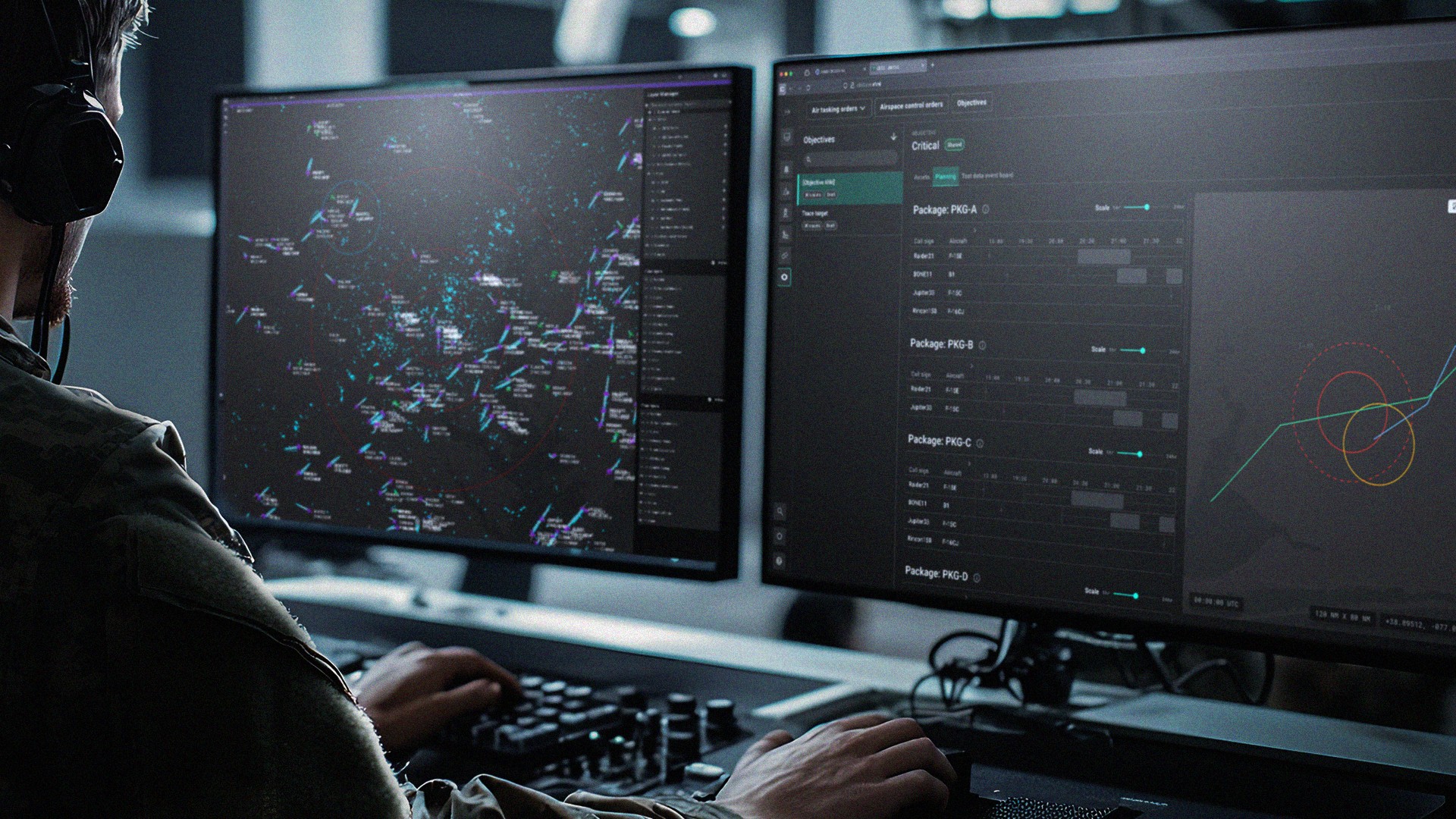
Hawkeye is a scalable mission planning tool developed in partnership with the Air Force Research Laboratory. At its core, it is a platform that lets operators assemble a complete mission package in one place: flight data, pilot profiles, communications channels, target maps, refueling schedules, and more. Everything a planning cell needs to brief, execute, and adjust a sortie lives inside a single coherent workspace.
The platform was designed with small teams in mind. These are units expected to build their own missions, respond to changes in real time, and relay updated objectives up the chain of command with no margin for ambiguity. Hawkeye gives them the infrastructure to do that without depending on systems that were never designed for this pace.
"The expectations placed on these operators to be correct are monumental. Hawkeye was designed to match that standard."
Planning Is Only Half the Picture
Once a mission package is built inside Hawkeye, it does not stay in the planning cell. Team members on the ground and leaders at high command can view active objectives across multiple theaters simultaneously. The platform turns a locally assembled plan into a globally visible operational picture, giving everyone in the chain access to the same information at the same time.
This long range monitoring capability is not a passive feature. It is what makes Hawkeye useful beyond the planning phase, transforming it from a data aggregator into a live coordination layer across the entire mission lifecycle.
A Proof of Concept with Real Stakes
Hawkeye is also something larger than a single tool. AFRL uses it as a case study to demonstrate that the capability exists today to replace existing legacy functionality. Through complex testing environments and isolated scenario aisles, the lab is progressively onboarding operators to validate the platform at scale before broader deployment.
The users at the center of that effort are mission planners, pilots, and general operators. Each group brings different needs to the table, and Hawkeye was designed to serve all of them without forcing any one group to adapt to a workflow built for someone else.
The Problem Worth Solving
The frustrations that drove Hawkeye's creation are not abstract. Operators are sleep deprived, consumed with tedious tasks, and operating in an environment where the cost of a mistake is not a lost hour but a failed mission. The administrative burden placed on these teams before any real work begins is a structural problem, not a personal one. Hawkeye treats it that way.
By collapsing the information gathering phase and making mission packages portable and visible across command levels, Hawkeye returns something to these operators that the existing toolkit takes from them: time, clarity, and the cognitive bandwidth to focus on the mission itself.
To view a full write-up of the project, contact me directly.